
Handle With Care
On language, listening, and the quiet return of something I'd thought I'd left behind

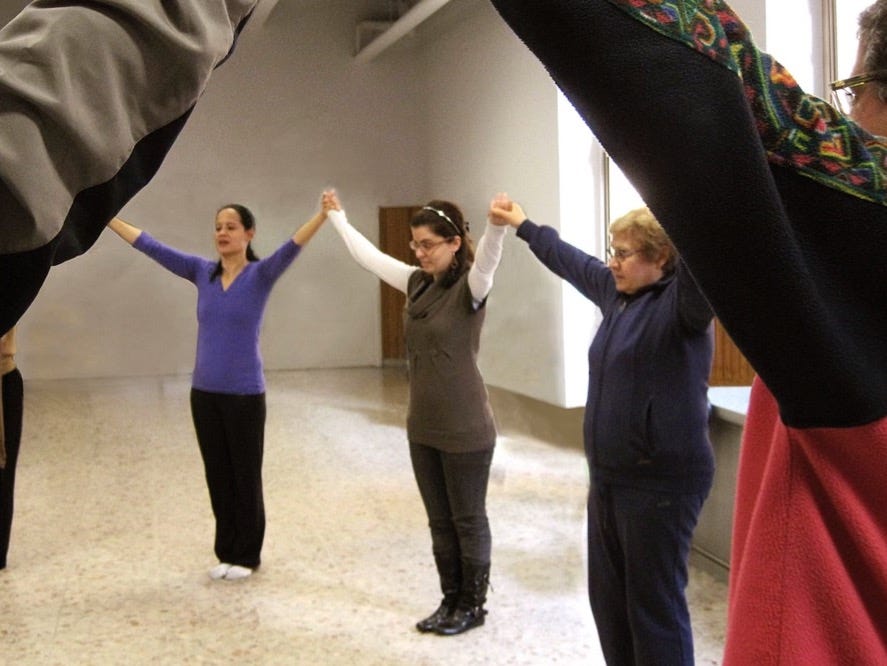
When I first moved back to the US from Italy, I left a job I loved in Rome, teaching a dance and movement class for people with Parkinson’s. Nothing in my training had prepared me for that work, but a dedicated neurologist believed I might be able to help. That belief shaped me, and what began as an unexpected offering became one of the most meaningful chapters of my teaching life.
When I arrived in Hudson, NY, where I now live, I wanted to build on that work. I believed that if I could learn to communicate with bodies whose nervous systems had been altered by illness, then I could teach anyone, more clearly, more precisely, and maybe even more honestly. That work led me to a mentor, a gifted teacher whose guidance had very little to do with flesh and bones. What I learned from him was not just anatomy or how to cue a body, but how to speak to it. And how to listen.
At the time, I was still dealing with an old shoulder injury. It had healed, technically, but it remained a tender spot. One day, early on, my mentor was guiding me through an exercise. I was frustrated, and said, “I could do this better if it weren’t for my stupid shoulder.”
He stopped immediately. “Don’t speak like that in my studio,” he said sternly.
I was confused. I hadn’t insulted anyone. I was just talking to myself.
“That’s exactly my point,” he said. “I wouldn’t speak to you like that. And you wouldn’t speak to a client like that. So why are you speaking to yourself like that?”
I didn’t have an answer. But I’ve never forgotten the question.
I hadn’t yet learned how deeply the body listens. And the truth is, that voice inside my head is not always kind.
The body hears everything.
Language carves pathways. What we say becomes what we believe. And what we believe becomes how we live inside our skin.
So now, when I teach, I try to hold language as carefully as I hold limbs. I no longer say “bad posture” or “wrong alignment.” I say, “Let’s try a different option.” I ask, “What would happen if we softened here?”
And when I speak to myself, I try to listen, too. I no longer say, “I can’t do this.” I ask, “What might change if I supported myself more?”
That shift may seem small, but it matters.

And just when I thought I had learned this lesson for good, life handed me a moment to test it.
Over the weekend, I was invited to participate in a dance performance this Fall. A multigenerational piece, performed in a barn, with dancers from the Merce Cunningham Company and a group of Bard students. An honor, a challenge, a calling. And I was terrified.
And that voice? It came back, louder than ever.
You can’t do this!
You’re too old!
You haven’t performed in over 20 years!
You’re not a dancer anymore!
The voice was sharp and certain. But this time, I paused.
What if I didn’t listen to that voice? What if I said yes? What if this wasn’t a threat, but a return? Not a test of worthiness, but a quiet invitation back to something I still love?
So I said yes. And in saying yes, I didn’t just reclaim movement, I reclaimed the part of me that deeply believes in it.
You’ll hear more about it come September. And if you’re local to the Hudson Valley, I’d love for you to come. I’ll be performing Beach Birds at The Round Barn in Churchtown on September 20, alongside a multigenerational cast that reminds me why movement matters at every age.
Until then, I’ll keep listening.
And I hope you will too.
XX KC

Is your body trying to tell you something? I’d love to hear about it in the comments. Or let’s decode the message together. I’m here to listen.
Beautiful words!
Super helpful reminder about the way we talk to ourselves :-)